📜 The Codex
A living wiki of roles, rules, and ruin in the kingdom under the dragon's shadow.
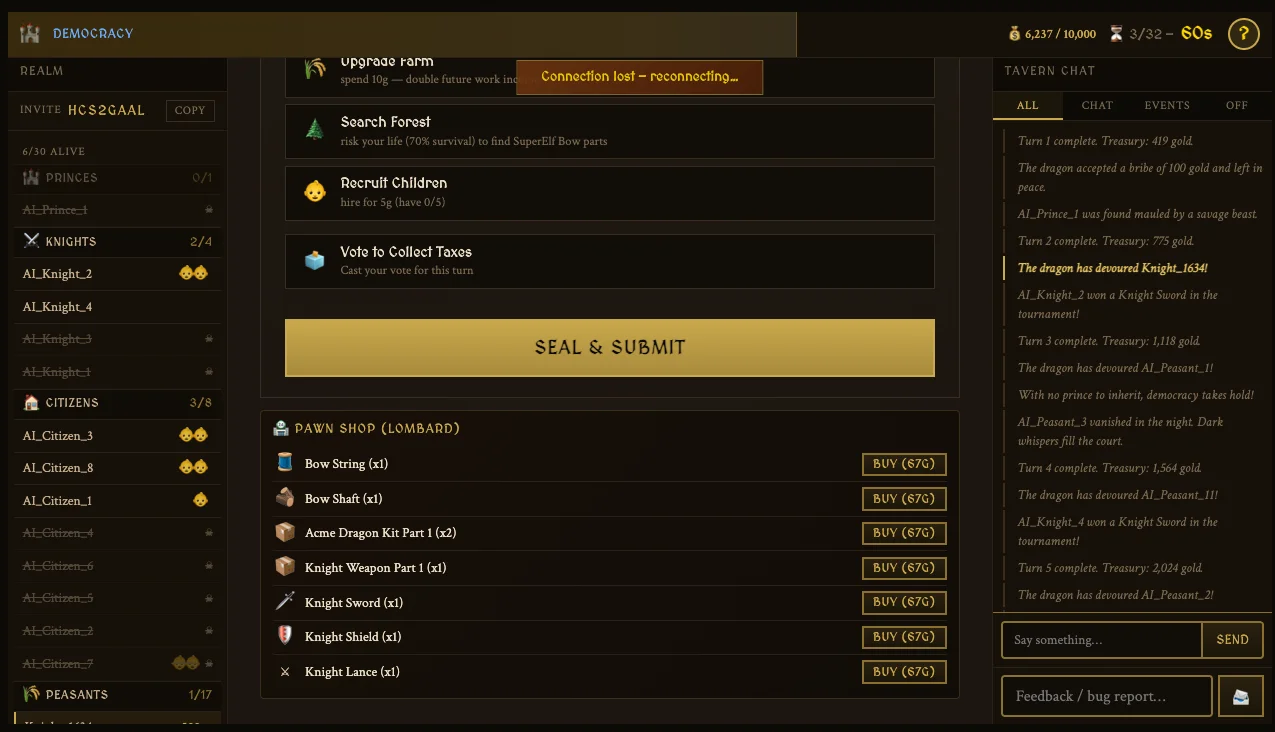
Welcome, adventurer. This is the player (and developer) reference for King & Dragon — a 31-player browser strategy game where everyone wins or loses together, and cooperation is the only path out from under the dragon's rule.
The Short Version
Fill the treasury to 10,000 gold within 32 turns, or kill the dragon. Everyone wins together. Everyone loses together. A single king sets tax rates and decides whether to bribe the dragon each turn. Thirty subjects scheme, farm, fight, betray, and occasionally try to slay the beast themselves.
Core systems
🏪
Pawn Shop (Lombard)
Where fallen players' gear returns to the economy. Recycling, not rebirth.
🌲
Forest Map Minigame
33 clickable areas, 3 unique bow parts, contested discovery, no do-overs.
🐉
The Dragon
Hunger, bribes, fire, and the three weapons that can end it.
⚔️
Roles & Classes
Peasant, Citizen, Knight, Prince, King — what each one can and can't do.
💰
Turn Economy
Declarations, taxes, actions, revolts, and how gold moves every turn.
🗡️
Special Functions
Thief, Assassin, Vampire, Werewolf — secret roles dealt at game start.
🏹
Dragon-Slay Paths
Three weapon sets, one dead dragon. Who can build what.
👑
How to Win (or Lose)
Victory conditions, draw states, and the ways a kingdom can collapse.
Game at a glance
What makes this game different
- Cooperative, not competitive — you don't win against other players, you survive with them (or despite them).
- Hidden tension — 4 of every 31 players has a secret "special function" they didn't ask for. Some of them kill for fun.
- Real-time turns — 60-second windows, SSE-driven, no page refreshes. What everyone does gets resolved at once.
- No stats or numbers — all hidden information is hidden. You never see another player's gold, items, or secret role.
- Drop-in / drop-out — anyone can take over an AI slot mid-game. Game sessions are 10–15 minutes each.
Quick navigation
| Looking for… | Go to |
|---|---|
| How the dragon decides who to eat | The Dragon |
| What "followers" do and how to recruit them | Turn Economy |
| The SuperElf Bow and the forest search mechanic | Forest Map Minigame |
| What happens when a player dies | Pawn Shop |
| The Thief, the Assassin, the Vampire, the Werewolf | Special Functions |
| Why the king matters (and why overthrowing one matters more) | Roles & Classes |
For developers
If you're reading this from the repo, the canonical source-of-truth docs are:
GAME_DESIGN.md— the full living design document (every mechanic, balance number, and rationale)game_config.yaml— the single source of truth for every game number (dragon hunger, turn length, action yields, role counts…)CLAUDE.md— engineering rules of the road for this projectserver/turn_resolver.py— the pure game-logic core. Read this to understand any mechanic at the code level.
Each wiki page ends with an Implementation notes section pointing at the specific files and functions that own that mechanic.